Saginaw — In mid-Michigan, the trees are bare. The campaign signs stand out more against the snow.
And in the 35th State Senate District—stretching across Bay, Midland, and Saginaw counties—voters have just made their first decision.
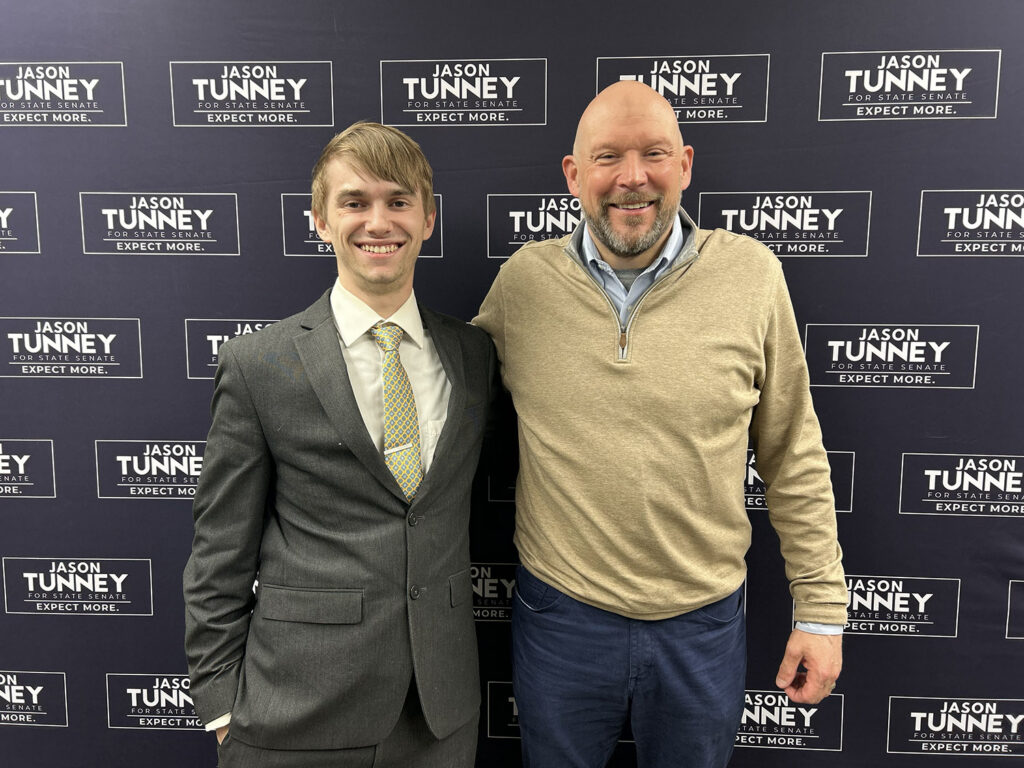
Earlier this month, Republicans chose Jason Tunney as their nominee in the special election to fill the vacant 35th District seat. On the other side of the ballot, Democrat Chedrick Greene secured his party’s nomination.
Now the two men will face off in the general election on May 5 that could determine more than just who represents this region in Lansing.
With Democrats currently holding a narrow majority in the Michigan Senate, the outcome of this race could reshape the balance of power at the state level. But for voters here, the stakes are about schools, roads, public safety, jobs, and the cost of living.
This is not a presidential election. It won’t dominate national headlines. But here, it matters.
For more than a year, Michigan’s 35th Senate District has been operating without something most voters assume is guaranteed: a voice in Lansing.
Jason Tunney wants that absence to be the entire story of this race. When I asked him what the biggest problem in the district is right now, Tunney didn’t hesitate.
“The single biggest problem is we don’t have any representation,” he said. “Our governor’s left us without a state senator for 411 consecutive days. That’s wrong. That’s undemocratic. That’s un-American. That’s why I’m running.”
It’s a simple argument, and it’s hard to ignore: If you pay taxes, you should have representation. Tunney frames this election less like a partisan contest and more like an overdue correction. He has a big proposal he wants to see passed.
“If citizens in a district are not represented for 120 days, then they don’t have to pay their state of Michigan taxes for that year,” Tunney said. “That should get the governor’s attention to call for that special election.”
You can call it aggressive. You can call it symbolic. But it’s the kind of idea that’s instantly understandable to regular people—and it captures what voters feel: that the district has been treated as optional.
He also suggested establishing firm vacancy deadlines—30, 60, 90 days—so a governor can’t simply let a seat sit empty without consequences.
Tunney said that if Republicans win in May, the legislation that comes from Lansing will have to have bipartisan support from the Senate.
Tunney doesn’t sell himself as a career politician. He sells himself as a local guy with a family, a work history, and a chip on his shoulder about how Lansing operates. He wants the state to be “a place where my sons can come back and have a good-paying job and raise their family.”
When I asked why he’s a better alternative to his opponent, he leaned on his four years as a former prosecuting attorney. After that, he went into his family’s small business, started by his grandfather.
That’s where he built the argument he returns to repeatedly: Lansing is insulated from consequences.
“I worked at a company that was never too big to fail,” Tunney said. “When we had to make decisions, we couldn’t just raise prices. People could go across the street and buy products from our competitors.”
His point: The government should feel pressure the way businesses and families do.Tunney’s policy set is built around a few big themes, and he keeps them grounded in everyday language.
He says Michigan needs jobs and a government that’s focused on creating them—without using taxes as the default tool.
He criticized what he sees as a habit of raising revenue instead of cutting inefficiency. Instead, Tunney wants attention turned inward—toward spending and structure.
He also made education a centerpiece—framing it as a threat not just to test scores, but to the state’s future.
On business, he argued Michigan is “overburdened” and “overregulated,” and that lawmakers should be judged by efficiency, not volume.
He argued Michigan should cut taxes, citing Michigan’s income tax at 4.25% and comparing it to Indiana and Ohio.
Finally, he emphasized public safety and law enforcement, linking it to recruitment and morale. He said the state should be trying to attract “the best and the brightest” into law enforcement, not pushing them away—and that Michigan needs to restore respect for public safety.
Tunney’s closing argument is ultimately about independence—someone who won’t just vote the party line. Win or lose, Tunney’s pitch is clear: The 35th District shouldn’t be treated like an optional seat.
His “taxation without representation” message is simple enough to repeat, sharp enough to travel, and personal enough to stick.
While his opponent campaigns on national issues, Tunney keeps the focus where it belongs: the 35th District. He’s asking voters to make this election about representation, accountability, and making sure Lansing never ignores this seat again.
Landen Taylor is a musician and explorer living in Bay City. Follow him on Instagram @landoisliving.