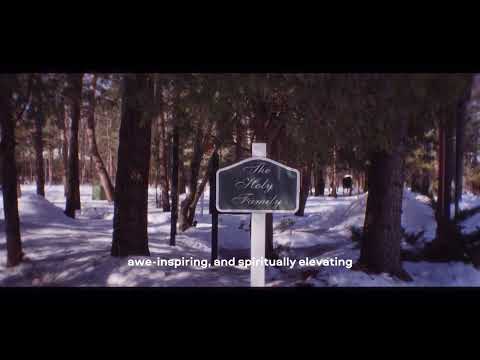
Kaleva — Every year, on the longest night of the year, hundreds of candles burn in a little cemetery in northern Michigan. The low winter sun slowly dips and orange light begins to flicker in that blue light that comes in the deep part of winter. The green pines stretching into the sky fade slowly into vertical black shadows, the sky becomes covered, and the cemetery glows in the silence.
Kaleva is a little town with a population of 507. Like most towns in northern Michigan it’s no more than a few streets blocked in a grid, a couple stores, modest homes, and a lot of trucks. In dry statistical terms, Kaleva isn’t particularly unique. But life isn’t only census data. Most towns in northern Michigan don’t light candles on their graves on the winter solstice. In fact, I don’t think I’ve ever seen candles being lit on gravestones on December 21st until I came here.

Life is more than statistics, though the explanation for the little lights on the darkest night can partially be explained by statistics. Kaleva was settled in the early 20th century by Finns. The town’s name is Finnish. The street names are Finnish. The last names on the graves in the cemetery are Finnish. And the tradition of lighting candles on gravestones is Finnish. It’s most common in Finland and Iceland, though it also happens here in places like Kaleva and other Finnish communities in the Upper Peninsula. Though most communities today light the candles on Christmas Eve, Kaleva is unique in their lighting directly on the winter solstice.
I sat there behind the wheel on Kaleva Street, parked next to Maple Grove Cemetery, with heat from the plastic vents pouring into the vehicle keeping my little cocoon warm, and my winter throat dry. At around 4:15 PM trucks started coming down the road, parking in front of me, behind me, and in open driveways wherever they were. A garage opened across the street, a table was set up, and brown paper bags in brown boxes were shuffled out. People got to work.

Old folks walked slowly on the ice, carrying a few bags across the street and into the snowy cemetery, carefully placing them on gravestones. Groups of high school students rode in the beds of trucks, grabbing as many bags filled with sand and candles as they could, driving back into the cemetery and covering as much territory as possible. They talked about school, sports, and debated what they should do if they don’t have enough bags for every grave. A couple dressed in camo and black dragged two young kids in a sled behind them as they trudged through the cemetery toward a truck with an open bed and a bunch of brown bags in back.
Over the course of an hour, people moved across the graveyard, tending to every stone. Once the light had faded just enough, the glowing orange inside the brown paper bags finally became faintly visible. Over the next hour the light in the sky became darker and the lights in the bags brighter until finally the little cemetery was lit with hundreds of beautiful glowing orange stations.

There’s a painfully heavy darkness in the north that’s very hard to understand unless you live here. It’s in the soul. The skies are endlessly gray, the ground is frozen for what feels like forever, the pines are more ominous than anything else, and the quiet of the winter feels like suffocation. We all light candles around this time of year no matter where we are or who we are. We all need that light in the night, a glimpse of hope, of life. But we need it more up here in the deep north. It’s perfectly unsurprising the people of Scandinavia started lighting their graves in frozen winter. A warm light of hope in the darkness of death.
Culture, heritage, tradition. We can’t watch them on a screen or buy them at the store. They aren’t passive things; they are acts. The Finnish tradition of lighting candles in Kaleva was lost for some time. It wasn’t until the mid 1990s they started honoring the tradition again. Culture, heritage, and tradition live when we act, and die when we don’t.

Sitting in my car, watching the people of Kaleva light their little cemetery on a freezing Sunday evening in late December, I thought about how none of it was done for money, or clicks, or fame, or anything materially frivolous. There was no fanfare, no outsiders there but me. There was only a little community coming together to light their graves on the darkest night of the year.
People stayed to admire their work for a few minutes. They took photos on their phones, remarked how, “It looks pretty good” and then they got in their trucks and drove home for dinner. One by one they left, and eventually all the noise died down. There were no more idling trucks or adolescent voices, only the glowing lights in the dark northern night.
O.W. Root is a writer based in Northern Michigan, with a focus on nature, food, style, and culture. Follow him on X @owroot.